信息学奥赛-提高级 题库
#include <cstdio>
using namepace std ;
const int maxn =1000;
int n;
int fa[maxn],cnt [maxn];
int getroot(int v ) {
if (fa[v] == v) return v;
return getroot(fa[v]);
}
int main ( ) {
cin >> n;
for (int i =0;i<n;++i){
fa[i]=i;
cnt[i]=1;
}
int ans = 0 ;
for (int i=0; i<n - 1; ++i){
int a,b,x,y,;
cin >>a>>b
x=getRoot(a);
y=getRoot(b);
ans +=cnt[x]cnt[y];
fa[x]=y;
cnt[y] +=cnt[x];
}
cout<<ans<<endl;
return 0;
}
本题t是s的子序列的意思是:从s中删去若干个字符,可以得到t;特别的,如果s=t,那么t也是s的子序列;空串是任何串的子序列。例如“acd”是“abcde”的子序列,“acd”是“acd”的子序列,但“adc”不是“abcde”的子序列。
S[x…y]表示s[x]…s[y]共y-x+1个字符构成的字符串,若x>y则s[x…y]是空串。t[x…y]同理。
#include <cstdio>
#include <algorithm>
using namespace std;
const int max1 = 202;
string s, t ;
int pre[max1], suf[max1]
int main() {
cin>>s>>t;
int slen =s. length(), tlen= t. length();
for (int I = 0 ,j = 0 ; i< slen; ++i) {
if (j< tlen&&s[i]t[j] ) ++j;
pre[i] = j;// t[0…j-1]是s[0…i]的子序列
}
for (int I = slen -1 ,j= tlen -1; I >=0;–i) {
if(j>=0&& s[i] == t [j]) –j;
suf [i]= j; //t[j+1…tlen-1]是s[i…slen-1]的子序列
}
suf[slen] = tlen -1;
int ans = 0;
for (int i=0, j=0, tmp=o; i<=slen; ++i){
while(j<=slen && tmp >=suf[j] + 1) ++j;
ans =max(ans, j – I – 1);
tmp = pre[i];
}
cout <<ans << end1;
return 0;
}
提示:
t[0…pre[i]-1]是s[0…i]的子序列;
t[suf[i]+1…tlen-1]是s[i…slen-1]的子序列。
(匠人的自我修养)一个匠人决定要学习n个新技术,要想成功学习一个新技术,他不仅要拥有一定的经验值,而且还必须要先学会若干个相关的技术。学会一个新技术之后,他的经验值会增加一个对应的值。给定每个技术的学习条件和习得后获得的经验值,给定他已有的经验值,请问他最多能学会多少个新技术。
输入第一行有两个数,分别为新技术个数n(1≤n≤103),以及已有经验值(≤107)。
接下来n行。第i行的两个正整数,分别表示学习第i个技术所需的最低经验值(≤107),以及学会第i个技术后可获得的经验值(≤104)。
接下来n行。第i行的第一个数mi(0≤mi<n),表示第i个技术的相关技术数量。紧跟着m个两两不同的数,表示第i个技术的相关技术编号,输出最多能学会的新技术个数。
下面的程序已O(n2)的时间复杂完成这个问题,试补全程序。
#inclde
using namesoace std;
const int maxn = 1001;
int n;
int cnt [maxn]
int child [maxn] [maxn];
int unlock[maxn];
int unlock[maxn];
int threshold [maxn],bonus[maxn];
bool find(){
int target=-1;
for (int i = 1;i<=n;++i)
if(①&&②){
target = i;
break;
}
if(target-1)
return false;
unlock[target]=-1;
③;
for (int i=0;i<cut[target];++i)
④;
return true;
}
int main(){
scanf(“%d%d”,&n, &points);
for (int I =1; i<=n;++i={
cnt [i]=0;
scanf(“%d%d”,&threshold[i],&bonus[i];
}
for (int i=1;i<=n;++i={
int m;
scanf(“%d”,&m);
⑤;
for (int j=0; j<m ;++j={
int fa;
scanf(“%d”, &fa);
child [fa][cnt[fa]]=i;
++cnt[fa];
}
}
int ans = 0;
while(find())
++ans;
printf(“%d\n”, ans);
return 0;
}
(取石子)Alice和Bob两个人在玩取石子游戏。他们制定了n条取石子的规则,第i条规则为:如果剩余石子的个数大于等于a[i]且大于等于b[il, 那么他们可以取走b[i]个石子。他们轮流取石子。如果轮到某个人取石子, 而他无法按照任何规则取走石子,那么他就输了。一开始石子有m个。请问先取石子的人是否有必胜的方法?
输入第一行有两个正整数,分别为规则个数n(1≤n≤64),以及石子个数m(≤10^7)。
接下来n行。第i行有两个正整数a[i]和b[i](1≤a[i]≤10^7,1≤b[i]≤64)
如果先取石子的人必胜,那么输出“Win”,否则输出“Loss”
提示:
可以使用动态规划解决这个问题。由于b[i]不超过64,所以可以使用64位无符号整数去压缩必要的状态。
status是胜负状态的二进制压缩,trans是状态转移的二进制压缩。
试补全程序。
代码说明:
“~”表示二进制补码运算符,它将每个二进制位的0变成1、1变为0;
而“^”表示二进制异或运算符,它将两个参与运算的数中的每个对应的二进制位一一进行比较,若两个二进制位相同,则运算结果的对应二进制位为0,反之为1。
ull标识符表示它前面的数字是unsigned long long 类型。
#include <cstdio>
#include<algorithm>
using namespace std ;
const int maxn =64;
int n,m;
int a[maxn],b[maxn];
unsigned long long status ,trans;
bool win;
int main() {
scanf("%d%d", &n, &m);
for (int i = 0; i<n; ++i)
scanf("%d%d", &a[i], &b[i]);
for(int i = 0; i < n; ++i)
for(int j = i + 1; j < n; ++j)
if (a[i] > a[j]) {
swap(a[i],a[j]);
swap(b[i],b[j]);
}
status = ___(1)___;
trans = 0;
for(int i = 1, j = 0; i <= m; ++i) {
while (j < n && ___(2)___) {
___(3)___
++j;
}
win = ___(4)___;
___(5)___;
}
puts(win ? "Win" : "Loss");
return 0;
}
2-3树是一种特殊的树,它满足两个条件:
(1)每个内部结点有两个或三个子结点;
(2)所有的叶结点到根的路径长度相同。
如果一棵2-3树有10个叶结点,那么它可能有( )个非叶结点。
甲乙丙丁四人在考虑周末要不要外出郊游。
已知①如果周末下雨,并且乙不去,则甲一定不去;②如果乙去,则丁一定去;③如果丙去,则丁一定不去;④如果丁不去,而且甲不去,则丙一定不去。如果周末丙去了,则甲________(去了/没去)(1 分),乙________(去了/没去)(1 分),丁________(去了/没去)(1 分),周末________(下雨/没下雨)(2 分)。(2018年提高组)
去了
没去
没去
没下雨
方程 a*b = (a or b) * (a and b),在 a,b 都取 [0, 31] 中的整数时,共有_____组解。(*表示乘法;or 表示按位或运算;and 表示按位与运算)(2018年提高组)
454
一只小猪要买 N 件物品(N 不超过 1000)。
它要买的所有物品在两家商店里都有卖。第 i 件物品在第一家商店的价格是a[i],在第二家商店的价格是 b[i],两个价格都不小于 0 且不超过 10000。如果在第一家商店买的物品的总额不少于 50000,那么在第一家店买的物品都可以打 95 折(价格变为原来的 0.95 倍)。
求小猪买齐所有物品所需最少的总额。
输入:第一行一个数 N。接下来 N 行,每行两个数。第 i 行的两个数分别代表 a[i],b[i]。
输出:输出一行一个数,表示最少需要的总额,保留两位小数。
试补全程序。(第一空 2 分,其余 3 分)
#include <cstdio>
#include <algorithm>
using namespace std;
const int Inf = 1000000000;
const int threshold = 50000;
const int maxn = 1000;
int n, a[maxn], b[maxn];
bool put_a[maxn];
int total_a, total_b;
double ans;
int f[threshold];
int main() {
scanf("%d", &n);
total_a = total_b = 0;
for (int i = 0; i < n; ++i) {
scanf("%d%d", a + i, b + i);
if (a[i] <= b[i]) total_a += a[i];
else total_b += b[i];
}
ans = total_a + total_b;
total_a = total_b = 0;
for (int i = 0; i < n; ++i) {
if ( (1) ) {
put_a[i] = true;
total_a += a[i];
} else {
put_a[i] = false;
total_b += b[i];
}
}
if ( (2) ) {
printf("%.2f", total_a * 0.95 + total_b);
return 0;
}
f[0] = 0;
for (int i = 1; i < threshold; ++i)
f[i] = Inf;
int total_b_prefix = 0;
for (int i = 0; i < n; ++i)
if (!put_a[i]) {
total_b_prefix += b[i];
for (int j = threshold - 1; j >= 0; --j) {
if ( (3) >= threshold && f[j] != Inf)
ans = min(ans, (total_a + j + a[i]) * 0.95
+ (4) );
f[j] = min(f[j] + b[i], j >= a[i] ? (5) : Inf);
}
}
printf("%.2f", ans);
return 0;
}
(1)a[i] * 0.95 <= b[i] 或 b[i] >= a[i] * 0.95
(2)total_a >= threshold 或 threshold <= total_a 或 total_a >= 50000 或 50000 <= total_a
(3)total_a + j + a[i]
(4)f[j] + total_b - total_b_prefix
(5)f[j - a[i]]
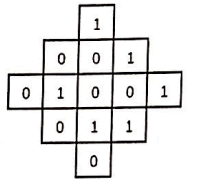
如右图所示,共有13个格子。对任何一个格子进行一次操作,会使得它自己以及与它上下左右相邻的格子中的数字改变(由1变0,或由0变1)。现在要使得所有的格子中的数字都变为0,至少需要 次操作。
3
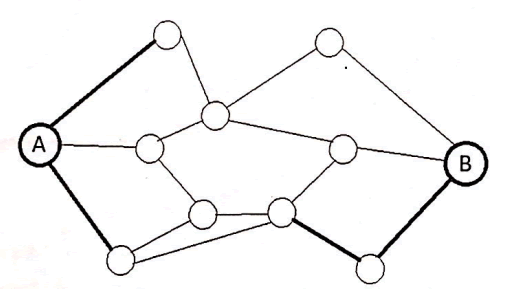
如下图所示,A到B是连通的。假设删除一条细的边的代价是1,删除一条粗的边的代价是2,要让A、B不连通,最小代价是_____(2分),最小代价的不同方案数是_______(3分)。(只要有一条删除的边不同,就是不同的方案)
4
9
(大整数除法)给定两个正整数p和q,其中p不超过10100,q不超过100000,
求p除以q的商和余数。(第一空2分,其余3分)
输入:第一行是p的位数n,第二行是正整数p,第三行是正整数q。
输出:两行,分别是p除以q的商和余数。
#include <iostream>
using namespace std;
int p[100];
int n, i, q, rest;
char c;
int main() {
cin >> n;
for (i = 0; i < n; i++) {
cin >> c;
p[i] = c - '0';
}
cin >> q;
rest = (1) ;
i = 1;
while ( (2) && i < n) {
rest = rest * 10 + p[i];
i++;
}
if (rest < q)
cout << 0 << endl;
else {
cout << (3) ;
while (i < n) {
rest = (4) ;
i++;
cout << rest / q;
}
cout << endl;
}
cout << (5) << endl;
return 0;
}
(1)p[0]
(2)rest<q 或 q>rest
(3)rest / q
(4)rest % q * 10 + p[i]
(5)rest % q
(最长路径)给定一个有向无环图,每条边长度为1,求图中的最长路径长度。(第五空2分,其余3分)
输入:第一行是结点数n(不超过100)和边数m,接下来m行,每行两个整数a,b,表示从结点a到结点b有一条有向边。结点标号从0到(n-1)。
输出:最长路径长度。
提示:先进行拓扑排序,然后按照拓扑序计算最长路径。
#include <iostream>
using namespace std;
int n, m, i, j, a, b, head, tail, ans;
int graph[100][100]; // 用邻接矩阵存储图
int degree[100]; // 记录每个结点的入度
int len[100]; // 记录以各结点为终点的最长路径长度
int queue[100]; // 存放拓扑排序结果
int main() {
cin >> n >> m;
for (i = 0; i < n; i++)
for (j = 0; j < n; j++)
graph[i][j] = 0;
for (i = 0; i < n; i++)
degree[i] = 0;
for (i = 0; i < m; i++) {
cin >> a >> b;
graph[a][b] = 1;
(1) ;
}
tail = 0;
for (i = 0; i < n; i++)
if ( (2) ) {
queue[tail] = i;
tail++;
}
head = 0;
while (tail < n - 1) {
for (i = 0; i < n; i++)
if (graph[queue[head] ][i] == 1) {
(3) ;
if (degree[i] == 0) {
queue[tail] = i;
tail++;
}
}
(4) ;
}
ans = 0;
for (i = 0; i < n; i++) {
a = queue[i];
len[a] = 1;
for (j = 0; j < n; j++)
if (graph[j][a] == 1 && len[j] + 1 > len[a])
len[a] = len[j] + 1;
if ( (5) )
ans = len[a];
}
cout << ans << endl;
return 0;
}
(1)degree[b]=degree[b]+1 或 degree[b]++ 或 ++degree[b]
(2)degree[i]==0 或 !degree[i]
(3)degree[i]=degree[i]-1 或 degree[i]-- 或 --degree[i]
(4)head=head+1 或 head++ 或 ++head
(5)ans<len[a] 或 len[a]>ans